Dilagent can be used in the proctological, gynecological and urological fields.
DILAGENT
A new device for treatment of Anal Fissure, Hemorrhoids and Anal Pain
DIRECTIONS FOR USE
In Proctology
It is indicated for the treatment of pathologies of the anorectal tract caused by sphincter hypertonicity such as anal fissure, hemorrhoids, anal pain and painful spasms after surgical treatments of the anorectal tract. It is also indicated in post-‐surgical strictures of the anus and anal canal.
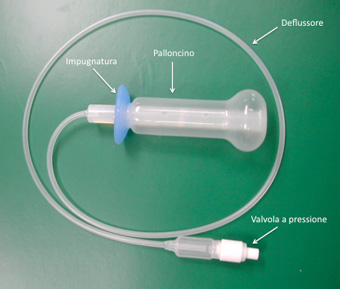
DIRECTIONS FOR USE
Before using the Dilagent:
- remove all air from the balloon by inserting a 50ml syringe into the non return valve and sucking the air out;
- sit in a bath of warm water for at least 5 minutes in order to clean and thoroughly relax the perianal muscles.
- remove all air from the balloon by inserting a 50ml syringe into the non return valve and sucking the air out;
- sit in a bath of warm water for at least 5 minutes in order to clean and thoroughly relax the perianal muscles.
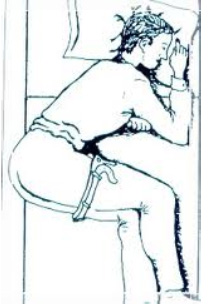
The left lateral position (Sims) is recommended for the insertion of the balloon (Fig. 2).
Alternatively, the balloon can be inserted while seated on the bidet.
Fill the syringe with warm water at a temperature of between 40–50 C° (hot water from the bath tap).
Lubricate the balloon completely deflated with the ointment contained in the kit, and very carefully insert it to its full length into the anal canal until the collar will be in contact with the anal skin. Pass the tube of the Dilagent up between the thighs and hold the non return valve (see figure 1) in the fingers.
Take the syringe, previously filled with 50ml of warm water, and insert it into the non return valve. Very slowly, start to inflate the balloon with 10 ml until you feel the sensation of heat in the anal canal. Gradually introduce more water until the balloon contains at least 30ml. Keep the Dilagent inserted for 12–15 minutes.
Lubricate the balloon completely deflated with the ointment contained in the kit, and very carefully insert it to its full length into the anal canal until the collar will be in contact with the anal skin. Pass the tube of the Dilagent up between the thighs and hold the non return valve (see figure 1) in the fingers.
Take the syringe, previously filled with 50ml of warm water, and insert it into the non return valve. Very slowly, start to inflate the balloon with 10 ml until you feel the sensation of heat in the anal canal. Gradually introduce more water until the balloon contains at least 30ml. Keep the Dilagent inserted for 12–15 minutes.

N.B. In the case of an acute anal fissure, with pain and bleeding, the introduction of 30 ml of warm water
could be painful. Therefore, it is recommended to introduce only 10-20 ml. at least for the first two or three days.
Fifty ml is the maximum quantity of water which has to be inserted into the balloon. After 12-15 minutes, deflate the balloon by sucking the water out with the syringe. Keep the Dilagent collar and extract it very slowly from the anus. Thoroughly wash the anal region with warm water and Sapigen K soap.
Dry with a soft cloth avoiding the use of toilet paper. Once extracted, wash the Dilagent with warm running water, and wash the balloon with the Marsiglia soap. Dry the balloon with a cloth and leave the Dilagent in a dry environment. NB. The special shape of the Dilagent allows movement and walking during its positioning.
So the patient is not obliged to lie in bed or be seated on the bidet. Nevertheless, it is recommended to limit sudden movements, avoiding any possible injury to oneself or to the Dilagent device.
could be painful. Therefore, it is recommended to introduce only 10-20 ml. at least for the first two or three days.
Fifty ml is the maximum quantity of water which has to be inserted into the balloon. After 12-15 minutes, deflate the balloon by sucking the water out with the syringe. Keep the Dilagent collar and extract it very slowly from the anus. Thoroughly wash the anal region with warm water and Sapigen K soap.
Dry with a soft cloth avoiding the use of toilet paper. Once extracted, wash the Dilagent with warm running water, and wash the balloon with the Marsiglia soap. Dry the balloon with a cloth and leave the Dilagent in a dry environment. NB. The special shape of the Dilagent allows movement and walking during its positioning.
So the patient is not obliged to lie in bed or be seated on the bidet. Nevertheless, it is recommended to limit sudden movements, avoiding any possible injury to oneself or to the Dilagent device.
HOW DOES THE DILAGENT WORK?
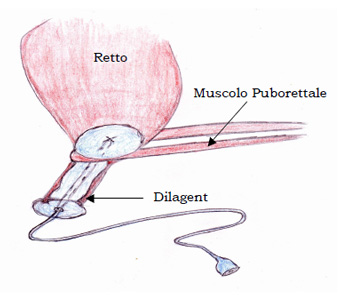
The Dilagent is gradually filled with warm water after being carefully inserted into the anal canal. The main feature is the patient's ability to control the volume of the balloon, depending on the symptoms. The special shape of the balloon guarantees the heat spreading to the anal canal (internal and external sphincters), to the puborectal muscle, but also to the muscles of the distal tract of the rectal ampulla, which are unavoidably involved in the hypertone. Thanks to the shape of its distal extremity, the balloon anchors itself to the pubrectal muscle, thus not moving during the patient's movements (Fig. 3).
The decreasing of the sphincteric hypertone ends to reduce the patient's pain.
TREATMENT SCHEDULE
The treatment should be continued for 3-‐4 weeks. The quantity of water introduced into the balloon should be equal to or more than
25 ml. As the painful symptoms decrease during the treatment, the patient must gradually increase the quantity of water into the balloon, till a maximum of 40–50 ml.
During the first week, the patient has to introduce into the balloon the quantity of water necessary to feel a sense of heat in the anal canal, arranging the amount of water according to the symptoms. Bear in mind that a greater introduction of water corresponds to a greater expansion of the balloon that is an essential condition for getting a complete healing.
The recommended treatment schedule for four weeks is as follows:
- before each treatment, do hot baths for 5 minutes to thoroughly relax the perianal muscles;
- for the first two weeks, use the Dilagent three times a day (morning, afternoon and evening) for 12–15 minutes each time;
- for the next two weeks, reduce the treatment to two times a day (morning and evening) for 12–15 minutes each time.
25 ml. As the painful symptoms decrease during the treatment, the patient must gradually increase the quantity of water into the balloon, till a maximum of 40–50 ml.
During the first week, the patient has to introduce into the balloon the quantity of water necessary to feel a sense of heat in the anal canal, arranging the amount of water according to the symptoms. Bear in mind that a greater introduction of water corresponds to a greater expansion of the balloon that is an essential condition for getting a complete healing.
The recommended treatment schedule for four weeks is as follows:
- before each treatment, do hot baths for 5 minutes to thoroughly relax the perianal muscles;
- for the first two weeks, use the Dilagent three times a day (morning, afternoon and evening) for 12–15 minutes each time;
- for the next two weeks, reduce the treatment to two times a day (morning and evening) for 12–15 minutes each time.
CONTRAINDICATIONS
There are no contraindications to the use of the Dilagent.
UNDESIRED SIDE EFFECTS
During the treatment there may be referred rectal tenesmus (constant sensation of wanting to go to the toilet), anal itching and a feeling of a wet anus. These symptoms are temporary and normally disappear at the end of the treatment. In the first week, above all in case of acute diseases (anal fissure, acute hemorrhoidal thrombosis), the pain may increase, especially during the first days. In such cases, it is recommended to not stop the treatment, but simply take a painkiller for reducing the pain. If the pain is such as to interrupt the therapy, the treatment should be suspended and the patient has to consult the Specialist.
SPECIAL PRECAUTIONS
The Dilagent is a medical device and must be used only for treating the pathologies described above. Its use is prohibited for any other aim.
THE DILAGENT USE IN GYNECOLOGY
In case of sexual sphere disorders, such as vaginismus (contraction of the vaginal muscles that make penetration painful or impossible during sexual acts), the DILAGENT can be used. The causes of this painful condition, are certainly multifactorial (hormonal, psychological, social factors) but the cause of the pain is in part certainly due to the hypertone of the levator ani muscle, very often associated with more or less significant hypertonicity of the entire pelvic floor muscles.
Recently, many treatments of the vaginismus (psychotherapy, anxiolytic therapy, Kegel exercises) have been proposed. Certainly, the reduction of the patient's anxiety and any psychological conflicts that support the muscular hypertone are fundamental but, evaluating the results, very often they are not sufficient to solve this debilitating trouble. The mechanism of action of the DILAGENT, in case of vaginismus, is based both on the transfer of heat to the muscles, and the dilatation of the vaginal vault (fig. 4).
The heat transfer is mainly carried out by the levator ani and puborectalis muscles, always involved in the pathophysiological mechanism of the vaginismus. By combining DILAGENT with psychological support, the results are truly important. DILAGENT is also used in trans gender patients during the postoperative period (from man to woman) to avoid a neo-vagina stenosis.
Recently, many treatments of the vaginismus (psychotherapy, anxiolytic therapy, Kegel exercises) have been proposed. Certainly, the reduction of the patient's anxiety and any psychological conflicts that support the muscular hypertone are fundamental but, evaluating the results, very often they are not sufficient to solve this debilitating trouble. The mechanism of action of the DILAGENT, in case of vaginismus, is based both on the transfer of heat to the muscles, and the dilatation of the vaginal vault (fig. 4).
The heat transfer is mainly carried out by the levator ani and puborectalis muscles, always involved in the pathophysiological mechanism of the vaginismus. By combining DILAGENT with psychological support, the results are truly important. DILAGENT is also used in trans gender patients during the postoperative period (from man to woman) to avoid a neo-vagina stenosis.
TREATMENT SCHEDULE IN GYNECOLOGY
It is practically the same used for proctological disorders. Obviously, the DILAGENT must be introduced into
the vagina. The patient's supine position is recommended, with legs slightly apart (fig 5). Remove the air from the balloon, lubricate the probe and insert it very gently into the vagina. Inflate the balloon progressively up to a maximum of 40-50 ml of hot water (40-45°C) using the syringe which is part of the kit.
Keep the probe inserted into the vagina vault for at least 10 minutes and repeat the application three or four times a day. It is recommended to perform the treatment with your partner in order to maintain complete relaxation during the treatment.
the vagina. The patient's supine position is recommended, with legs slightly apart (fig 5). Remove the air from the balloon, lubricate the probe and insert it very gently into the vagina. Inflate the balloon progressively up to a maximum of 40-50 ml of hot water (40-45°C) using the syringe which is part of the kit.
Keep the probe inserted into the vagina vault for at least 10 minutes and repeat the application three or four times a day. It is recommended to perform the treatment with your partner in order to maintain complete relaxation during the treatment.
Fecal incontinence: sphincter rehabilitation
After sphincter rehabilitation surgery for fecal incontinence, the DILAGENT can be used to perform active "gymnastics" which favors the recovery of sphincter tonicity.
Mechanism of action
The balloon is inserted into the anal canal and filled with 25 ml of warm water. The patient performs voluntary contractions of 2 seconds each interspersed with pauses of 4-5 seconds. There are three or four sessions per day, lasting 10 minutes each. Through these simple measures, an improvement in external (voluntary) but also internal (involuntary) sphincter tone is achieved. In fact, an increase in muscle tropism is observed. The use of DILAGENT for rehabilitation purposes after sphincter repair operations is therefore very useful.
In Urology
DILAGENT is also used in the urological field for rehabilitation purposes in stress urinary incontinence. The pubococcygeus muscle is involved both in the regulation of urinary flow and in the control of the birth tract.
Some factors that can reduce its efficiency are pregnancy, obesity and menopause. In such cases the DILAGENT is introduced into the vagina vault, and the balloon is filled with 30 ml of warm water.
The patient is asked to perform contractions of 2 seconds each interspersed with pauses of 4 seconds, for an overall duration of 10 minutes. Three sessions a day are recommended. The alternation of contraction and relaxation repeated several times, strengthens the urinary sphincter and pelvic muscles, reducing uncontrolled urinary leakage (Fig. 6).
Some factors that can reduce its efficiency are pregnancy, obesity and menopause. In such cases the DILAGENT is introduced into the vagina vault, and the balloon is filled with 30 ml of warm water.
The patient is asked to perform contractions of 2 seconds each interspersed with pauses of 4 seconds, for an overall duration of 10 minutes. Three sessions a day are recommended. The alternation of contraction and relaxation repeated several times, strengthens the urinary sphincter and pelvic muscles, reducing uncontrolled urinary leakage (Fig. 6).


